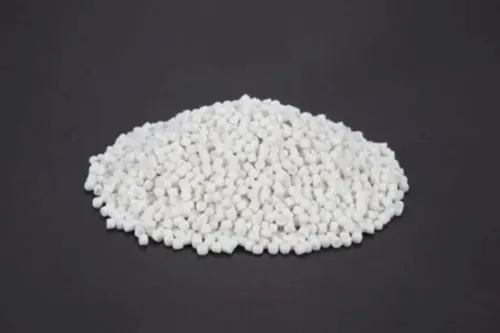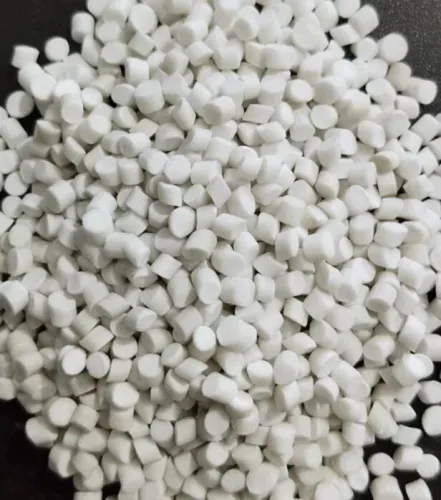
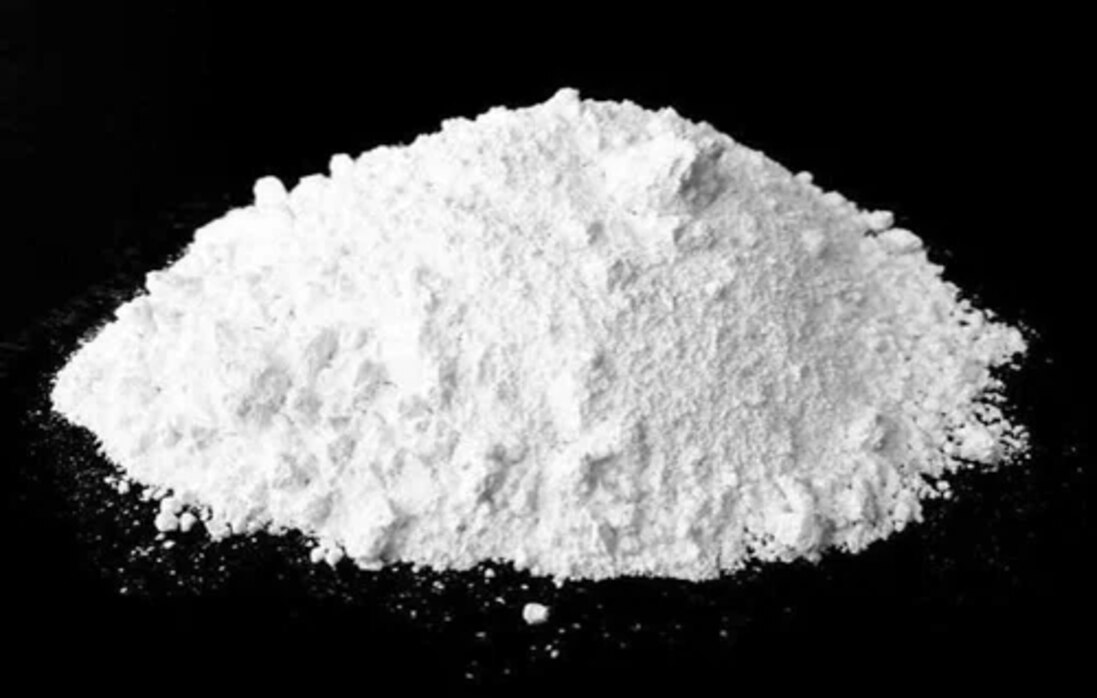
Calcium carbonate can lower formulation cost and increase stiffness, but the wrong grade or loading can reduce impact strength, delay fusion, damage surface quality, and destabilise processing. By the end, you will be able to match GCC or PCC to an application, set a sensible loading range, and qualify the powder inside the complete PVC formulation.
Key takeaways
- Match particle size, coating and moisture data to the PVC application.
- Increase filler loading only after checking impact strength, fusion and surface finish.
- Use controlled feeding and adequate mixing to prevent agglomerates and extrusion defects.
- Qualify suppliers with batch data, trial results and finished-compound testing.
What calcium carbonate changes in a PVC compound
At about 2.7 g/cm³, calcium carbonate is far denser than unfilled PVC at roughly 1.4 g/cm³. Its calcium carbonate function in PVC is to replace part of the polymer with a mineral filler, raising stiffness, dimensional stability, density and opacity while reducing resin use. Correct dispersion can also improve surface finish; agglomerates do the opposite.
Judge the saving by cost per volume, not cost per kilogram. A low-priced powder occupies less volume per kilogram than PVC, so compare the material cost of a finished cubic metre or part at its target density.
Higher loading also changes thermal mass, cooling rate and shrinkage, which can force adjustments to die temperature, haul-off speed and cooling calibration.
Calcium carbonate is not a universal substitute for other additives or minerals:
- A reinforcing filler creates stronger polymer–particle load transfer; ordinary calcium carbonate mainly provides stiffness adjustment and volume replacement.
- A plasticiser softens PVC and increases flexibility; calcium carbonate usually raises modulus and reduces elongation.
- A heat stabiliser protects PVC during processing; a pigment supplies colour or hiding power; a processing aid improves fusion, melt flow or surface release.
- Talc can increase stiffness, hardness and barrier performance; kaolin changes opacity and processing; silica affects wear and surface behaviour; dolomite changes hardness, colour and mineral balance.
Calcium carbonate reacts with acids, releasing carbon dioxide and forming calcium salts. Stearic-acid coating improves wetting, compatibility and agglomerate control, but it does not make the mineral acid-proof. Avoid untreated or coated grades where sustained acid exposure is part of service.
How to read a calcium carbonate grade specification
A calcium carbonate grade works only when its particle-size distribution, surface area, chemistry and coating match the PVC formulation and process. D50 alone cannot predict performance: a broad upper tail, coarse particles or agglomerates can create stress concentrators, roughness and feeding faults.
| Form | Morphology and surface demand | Formulation consequence |
|---|---|---|
| Ground calcium carbonate | Milled mineral particles; broader shape and distribution | Lower surface demand; economical starting point |
| Precipitated calcium carbonate | Finer, more controlled morphology and higher specific surface area | Greater lubricant or dispersant demand; changes fusion, viscosity, gloss and impact |
Review the complete distribution, including the coarse-particle tail and agglomerate content. Also compare specific surface area, oil absorption, whiteness, moisture, calcium carbonate purity and mineral impurities. Fine powder is not automatically better: its larger surface area can increase melt viscosity, lubricant demand and unstable extrusion amperage.
Stearic-acid or stearate coating improves wetting, powder handling and filler–filler agglomeration control. Excess coating acts as lubricant, reducing interfacial adhesion, delaying PVC fusion, changing torque and weakening the compound if the lubricant balance is not reset.
For light-coloured, electrical or weatherable products, set limits for iron-bearing impurities because they can darken colour and worsen weathering. Specify silica and quartz limits for equipment-sensitive compounds; hard contaminants increase screw, barrel and die wear and can cause surface defects.
- D10, D50, D90, coarse-particle and agglomerate limits
- Specific surface area, oil absorption, moisture and coating dosage
- Whiteness, purity, iron, silica and quartz results
- Lot traceability and a sample for a full-formulation trial
Choosing loading by PVC application and performance target
Start rigid PVC at a CaCO3 loading range of 5–20 phr, then increase only after trials on the finished product and processing line. Higher loading generally raises modulus, density and dimensional stiffness while reducing polymer fraction, elongation and notched impact strength.
| Application | Practical loading direction | Performance checks |
|---|---|---|
| Rigid PVC pipe | Begin within 5–20 phr; increase cautiously for cost reduction | Pressure strength, Charpy or Izod impact, low-temperature impact and density |
| PVC profiles and sheets | Often tolerate more than pipe; boards and sheets can go higher | Corner-weld performance, fusion, surface finish, extrusion torque and dispersion |
| Cable insulation | Keep loading conservative | Elongation, flexibility, electrical insulation, density and low-temperature performance |
| Footwear | Moderate loading for stiffness and cost control | Flex fatigue, softness, abrasion and surface quality |
| Film | Low loading where clarity and elongation matter | Clarity, haze, tear strength, surface finish and dispersion |
| Injection moulding | Select loading for stiffness without mould-flow loss | Weld lines, impact, shrinkage, surface finish and moulding torque |
| Flexible PVC | Use less filler when softness and elongation are priorities | Hardness, elongation, flexibility, density and compound cost |
Treat density, low-temperature impact, corner-weld performance, clarity, surface finish and compound cost as separate decisions. A tensile result alone does not validate loading; a compound can pass tensile strength and fail impact or weld-line testing.
Fine powder is not automatically better: its greater surface area increases lubricant or dispersant demand and can worsen fusion, torque or finish if the formulation is not rebalanced. Compare cost per volume, not only cost per kilogram, before approving higher loading.
Incorporating the powder without destabilising extrusion or moulding
A damp or poorly dispersed powder can turn a stable PVC line into a source of pinholes, streaks, voids and filter blockage. Treat calcium carbonate as a process input, not a late correction to the PVC compounding process.
1. Check the incoming powder’s moisture, packaging, batch condition and storage history. Use moisture control to prevent rehumidification; dry or condition the powder when the incoming result requires it. Break up settled agglomerates before feeding.
2. Follow the planned premixing order: blend PVC resin with the heat stabiliser and selected additives, then add calcium carbonate under controlled mixing. Feed it at a steady rate and provide enough shear to wet and disperse particles without overheating the blend.
3. Introduce lubricants, impact modifiers, plasticisers, pigments, flame retardants and processing aids according to the formulation’s dispersion and fusion needs. Record melt torque and fusion time, because a filler change can alter both; do not compensate blindly by adding lubricant.
4. Hold residence time, feed rate and temperature stable while checking die pressure, throughput, surface streaks, fisheyes and filter loading. Inspect polished sections when dispersion is uncertain. Excessive shear or abrasive coarse particles increase screw wear and die build-up, while poor dispersion survives into pelletising and creates inconsistent cooling.
Calcium carbonate does not replace the PVC heat-stabiliser system. It can consume hydrogen chloride during degradation, but the resulting calcium chloride, water and carbon dioxide do not provide long-term colour or processing protection. A new filler grade can require revised die temperature, haul-off speed, cooling calibration, shrinkage control and lubricant balance.
How to qualify a calcium carbonate supplier and finished compound
A certificate of analysis proves reported numbers, not processing performance. Qualify a new calcium carbonate grade in a controlled trial using the complete formulation, intended loading, and actual equipment; changing only the powder can alter PVC fusion through moisture, coating, oil absorption, or particle-size tail.
Compare the new and current powders at equal phr and equal cost per volume. Record bulk density, feeding stability, pelletising behaviour, die deposits, melt pressure, torque/current history, and surface inspection results.
| Check | Evidence | Failure signal |
|---|---|---|
| Dispersion testing | Microscopy of polished sections and ash or calcination-based filler verification | Agglomerates, voids, or incorrect filler level |
| Performance | Density, tensile, elongation, Charpy or Izod impact, weld-line or corner-weld testing, and low-temperature testing where relevant | Impact, weld, or cold-temperature failure despite passing tensile |
| Process quality | Moisture testing, stable pressure, torque, current, pelletising, and surface records | Streaks, pinholes, deposits, or unstable feeding |
Require lot traceability and written limits for purity, moisture, particle-size distribution, coating, oil absorption, and impurities such as iron, silica, and quartz. Use batch consistency as a release criterion, not a claim.
Aim Plastic can help by discussing a grade against your application, formulation, and processing method, rather than treating one powder as suitable for every PVC compound.
Related product
 | Calcium Carbonate Powder Aim Plastic stands as one of Delhi's leading calcium carbonate powder manufacturers in delhi, producing high-grade CaCO3 for diverse industrial... View product → |
Frequently asked questions
What does calcium carbonate change in a PVC compound?
It increases stiffness, dimensional stability, density and opacity while replacing part of the PVC resin. Poor dispersion creates agglomerates and rough surfaces.
Which calcium carbonate specification should you compare?
Compare calcium carbonate content, particle-size distribution, moisture, surface treatment, whiteness and batch-to-batch consistency. Check whether the grade is coated for the intended PVC process.
How do you choose calcium carbonate loading for PVC?
Set loading against the application’s stiffness, impact, surface-finish, weight and cost targets. Higher loading can reduce resin use but may reduce impact strength and complicate fusion or processing.
How can you prevent calcium carbonate from destabilising processing?
Control powder moisture, feed rate and dispersion. Use compatible mixing conditions, prevent agglomerates and confirm torque, melt pressure, surface finish and dimensions during trials.